
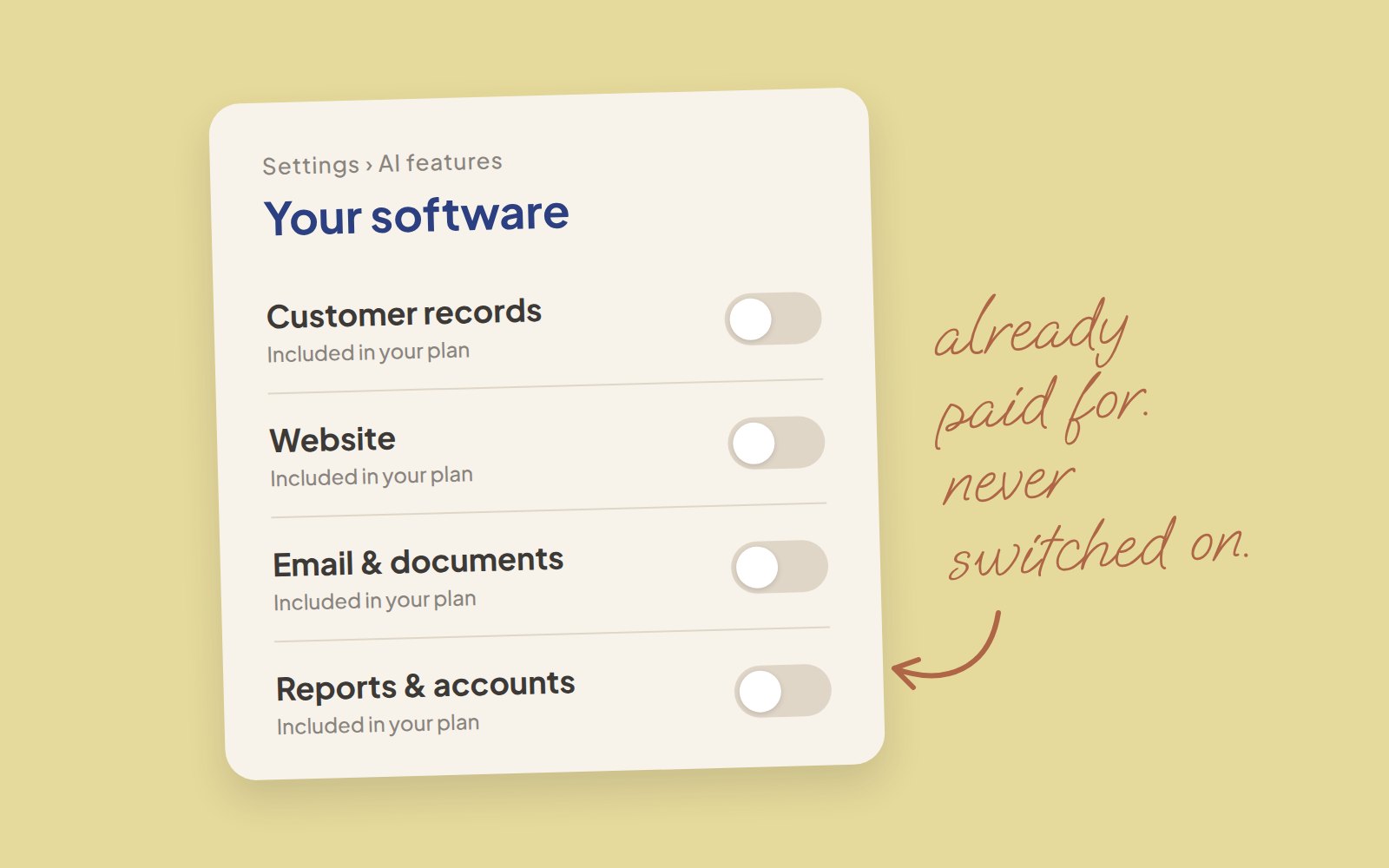
Somewhere in your business, someone is pasting a customer’s email into a free AI app on their phone to help write the reply. It’s resourceful. Meanwhile, quietly, the systems that hold your customer records, your website, your email and your accounting software have each added AI in their latest updates. Much of it is already included in what you pay. Most of it has never been switched on.
The question isn’t only which new tool to buy. It’s what the tools you already own could do if you used them differently.
Do you need a new AI tool, or can you use the AI you already have?
Often the best place to start is the software you already pay for. Your customer records, website, email and reporting tools hold what AI needs to be useful: knowledge of your customers, your products and the way you work. Check what’s already built in, and what problem it could solve, before you buy anything new.
Your people are already a step ahead. In Microsoft and LinkedIn’s 2024 Work Trend Index, three in four knowledge workers were using AI at work, and 78% of them were bringing their own tools. Which means the business often has little say in what information goes where.
Why does the software you already have matter so much?
Because AI is only as useful as what it knows. A general chatbot knows a great deal about the world and almost nothing about your business. Your own systems know your customers, their history, your products, your prices and the way you talk to people. That context is what turns a clever tool into a useful one.
There’s a difference, too, between one person using AI to write an email faster and AI built into the way the business runs. The first saves someone ten minutes. The second can change what your business is able to do.
Where might AI already be waiting in your business?
These are the four places we look first, and the question worth asking at each.
1. Your customer records
The system that tracks your enquiries, sales and customer conversations is often the most valuable place to start. Depending on what you use, its AI may be able to spot patterns across thousands of interactions, suggest who to follow up first, summarise a customer’s history before a call, or show where people drop out between enquiry and sale.
Ask: What do our customer records know that nobody has time to read?
2. Your website
Your website holds years of product information, answers to common questions, case studies and the language your brand uses. AI built into website platforms can help keep that content fresh, help customers find what they’re looking for, and turn what you already know into a starting point rather than a blank page.
Ask: Which customer questions does our website already answer, if only people could find it?
3. Your everyday tools
Email, documents, calendars and meetings. Most office software now offers AI that can summarise a long thread, draft a first version, take meeting notes or pull together a document from what’s already been written. It’s rarely glamorous, but it gives time back every single day.
Ask: How many hours a week do we spend writing, sorting and summarising?
4. Your reports and accounts
Accounting and analytics tools increasingly explain numbers in plain English, flag what has changed and answer questions without someone building a spreadsheet. That can help the people making decisions understand what’s happening sooner.
Ask: Which reports do we produce that nobody actually reads?
Can AI fix a disconnected business?
No. If your customer information is incomplete, scattered across different systems or not trusted by the people who use it, AI won’t make it reliable. It will simply work faster with what it’s given.
AI doesn’t magically fix a disconnected business. Sometimes it simply makes the disconnection faster.
The same goes for broken processes. If customers are asked for the same information three times, or a report takes hours because nobody agrees which numbers matter, the answer isn’t to automate it. Fix the friction first, then decide whether technology can help.
What should your people still own?
Not everything should be handed to software. Some decisions need judgement. Some conversations need empathy. Some ideas need creativity, and some calls are simply too important to delegate. The goal isn’t to take people out of the work. It’s to give them better information, better tools and more time for the parts that matter.
How do you find out what you already have?
Start with a simple list of the software you pay for, and check what AI is already included in each subscription, what’s switched off, and what would need an upgrade. Then pick one point of friction, such as slow follow-ups or hours lost to reports, and test what your existing tools can do about it.
Before anyone switches anything on, agree your ground rules: which tools are approved and what information can go into them. We cover that in Where should AI start in your business?
So, is your best AI opportunity already in the software you pay for?
Often, yes. It might be in the customer system you’ve had for five years, the website your team updates every week, or the office software everyone opens each morning. The businesses that do well with AI won’t necessarily be the ones with the most tools. They’ll be the ones that know what they already have, and use it well.
The best AI strategy rarely starts with AI.
If you’d like help working out what your existing technology could do for you, a Clever Fix is a good place to start.