

Everyone is talking about AI. Your team is already trying ChatGPT. Every software provider you pay has announced something new. And there’s a quiet worry that everyone else is further ahead.
It’s tempting to pick a tool and get going. But the businesses getting real value from AI didn’t start with a tool. They started with a problem worth solving.
Where should AI start in a business?
AI should start with a business problem, not a tool. The best places to begin are where your team loses time to repetitive work, where decisions take longer than they should, or where customers feel unnecessary friction. Find the problem first, then choose the technology that solves it.
You’re not alone in finding this hard. In KPMG’s 2026 survey of Australian family businesses, half named AI adoption and governance as one of their biggest short-term challenges, well ahead of the global figure.
Why is AI a business decision, not an IT project?
Because the value doesn’t come from the software. It comes from what the business does differently with it. AI often gets handed to IT, or to whoever in marketing is most enthusiastic. The businesses making real progress treat it as a business capability that runs across their people, their processes and the technology they already use.
We’ve seen this first hand. In one retirement living organisation, the work didn’t begin with choosing an AI platform. It began with finding where the customer experience and decision making could be better. That led to AI agents, business data and documentation brought into shape for use across the organisation, and the foundations for a connected CRM and website that gave everyone a single view of the customer.
The technology followed the strategy. Not the other way around.
Where should you look for AI opportunities, and what should you ask?
Start with friction, not features. These are the five places we look first, and the question worth asking at each.
1. Your team’s time
Every business has work that takes hours and adds little: re-keying information, formatting reports, answering the same question for the tenth time. It’s rarely anyone’s favourite part of the job, and it’s often where AI earns its keep fastest.
Ask: Where are our people spending time on work that adds little value?
2. Your decisions
Some decisions take longer than they should because the information arrives late, in pieces, or not at all. AI can pull it together, summarise it and surface what matters, so the people making the call can make it sooner and with more confidence.
Ask: Which decisions take longer than they should, and what would help us make them faster?
3. Your customers’ experience
Look for the moments where customers wait, repeat themselves or give up. A slow reply, a hard-to-find answer, a handover that loses the thread. These are growth problems as much as service problems, and they’re often where AI makes the most visible difference.
Ask: Where do our customers experience unnecessary effort?
4. Your information
Most businesses know far more than they can easily use. It sits in inboxes, shared drives, spreadsheets and people’s heads. AI is only as good as what it can draw on, so getting your information organised is often the most valuable first step, and the least glamorous.
Ask: What do our people struggle to find, and where does it actually live?
5. Your systems
AI isn’t just a chatbot. Tools like ChatGPT and Microsoft Copilot are a great place to experiment, but increasingly the real value is built into the systems you already pay for: your CRM, your website platform, your marketing automation, your service and reporting tools. The opportunity is often already switched on, and simply unused.
Ask: Are we getting the most from the AI already built into the platforms we use?
Why shouldn’t AI stay inside one team?
Many businesses start by giving one team access to ChatGPT or Copilot. Marketing experiments, HR writes a policy, sales drafts emails. Each is useful on its own, but together they add up to scattered effort rather than real change.
The bigger gains come when AI is treated as something the whole business shares: agreed rules, connected systems and common ways of working. That’s when people, processes and technology start improving together.
How should you start?
With your ground rules. Before anyone switches on a new tool, agree a simple governance framework: what’s in and what’s out. Which tools are approved, what information can go into them, and who checks the work before it reaches a customer.
It sounds formal, but it’s what makes everything after it easier. Every decision about implementation has something to be measured against, and your team can get on with it instead of guessing.
It’s also a cyber security question, whatever your size. Every time someone pastes a customer list, a contract or the latest financials into a free AI tool, that information has left your business. A team of ten needs to think about that as much as a team of a thousand.
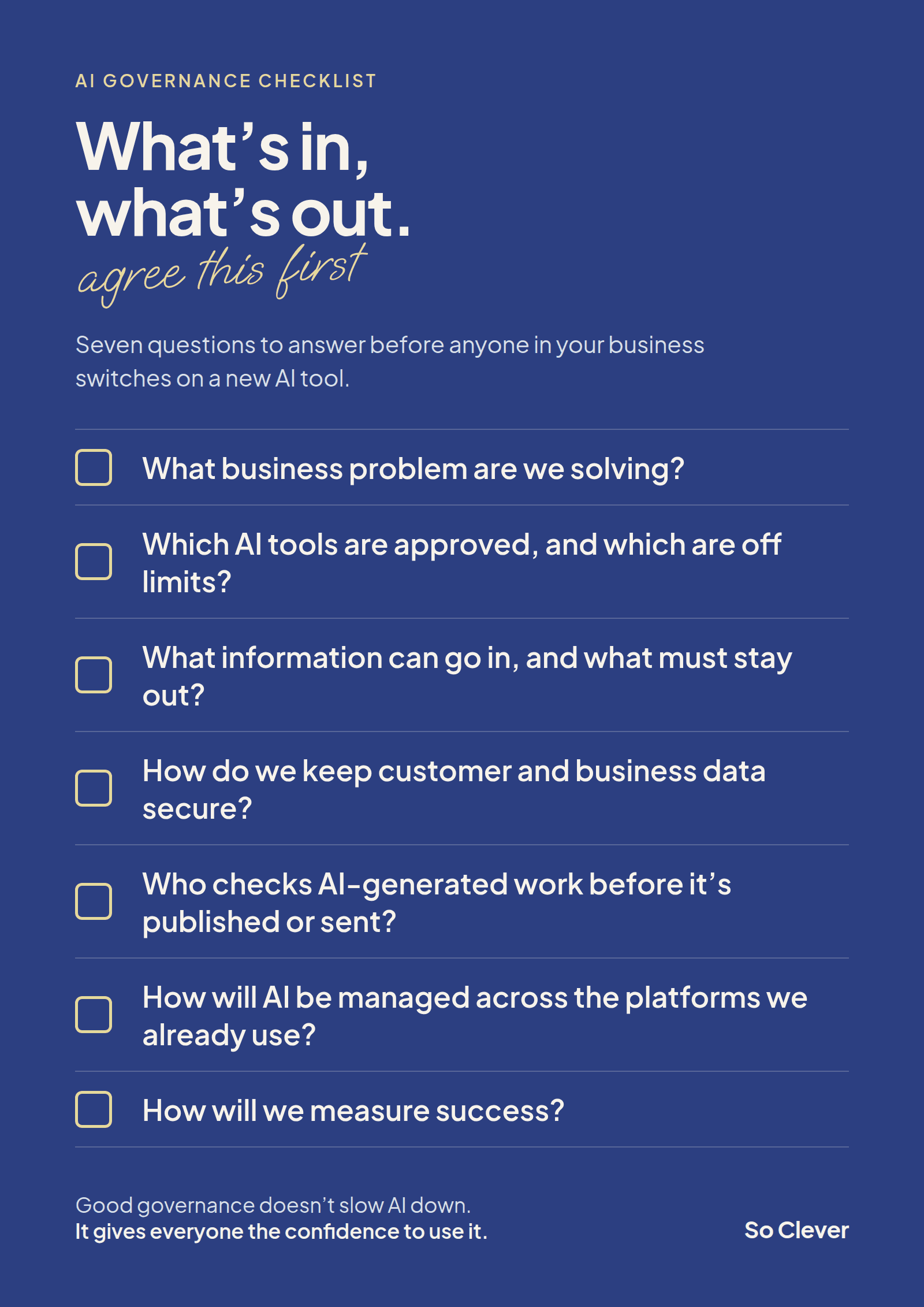
Good governance doesn’t slow AI down. It gives everyone the confidence to use it.
Then start small, and with intent. You don’t need a business-wide rollout on day one. Pick one or two problems where the value is clear and the result can be measured, and do those well.
Early wins create confidence. Confidence builds capability. Capability creates momentum.
So, where should AI start in your business?
With the problem that matters most. AI will keep changing, and new capabilities will soon be standard in almost every platform you use. But the businesses that start with a clearly defined problem, and a clear view of the outcome they want, will always make better technology decisions than those chasing the latest tool.
Technology changes quickly. Clear thinking doesn’t.
If you’d like help working out where AI could make a real difference in your business, let’s start the conversation.
